

Wer von Mastodon kommt, kennt die einfache Möglichkeit Hashtags zu folgen um seine Timeline dank fehlender Algorithmen interessant zu füllen. Bei Hubzilla geht das auch, über einen kleinen Umweg mit noch viel besseren Einstellmöglichkeiten.
Zuerst definiert man einen Link dem man den gewünschten Tag anhängt auf https://relay.fedi.buzz/tag/
Sieht dann so aus, für beispielsweise dem Hashtag "hubzilla:
Dann geht man auf seiner Instanz auf "Verbindungen"
Translated with DeepL.com (free version)

Dort gibt man die eben erstellte Channeladresse ein und klickt auf das Plus woraufhin sich ein neues Fenster öffnet:

Interessant ist hierbei das Feld "Filter für den Inhalt" - "Nur Beiträge mit diesem Text importieren" und "Beiträge mit diesem Text nicht importieren"

Mit "lang=de" werden nur deutsche hubzilla-Beiträge angezeigt. Man kann zwar an anderer Stelle in der Administration auch einstellen das nur deutsche Beiträge angezeigt werden sollen, aber vielleicht will man woanders ja auch englische haben. Hier gilt das nur für den definierten Hashtag.
Beim Feld darunter könnte man mit "lang=cn" alle Sprachen abrufen außer chinesisch. Hier findet man weitere Ländercodes: Ländercodes nach ISO-3166
Mit ein bischen rumprobiererei kann man sich seinen Feed perfekt anpassen. Die Felder Rollen und Privacygruppen kann man hier vernachlässigen weil der Hashtag keine Userrechte braucht, er agiert ja nicht.
#Hubzilla #Mastodon #Hashtags
Zuerst definiert man einen Link dem man den gewünschten Tag anhängt auf https://relay.fedi.buzz/tag/
Sieht dann so aus, für beispielsweise dem Hashtag "hubzilla:
https://relay.fedi.buzz/tag/hubzillaDann geht man auf seiner Instanz auf "Verbindungen"
Translated with DeepL.com (free version)
Anyone who comes from Mastodon knows how easy it is to follow hashtags to fill their timeline with interesting content thanks to the lack of algorithms. This is also possible with Hubzilla, via a small detour with even better settings options.
First, define a link to which you attach the desired tag on https://relay.fedi.buzz/tag/
It will then look like this, for example, for the hashtag "hubzilla:https://relay.fedi.buzz/tag/hubzilla
Then go to “Connections” on your instance.
Dort gibt man die eben erstellte Channeladresse ein und klickt auf das Plus woraufhin sich ein neues Fenster öffnet:
Enter the channel address you just created and click on the plus sign, which will open a new window:
Interessant ist hierbei das Feld "Filter für den Inhalt" - "Nur Beiträge mit diesem Text importieren" und "Beiträge mit diesem Text nicht importieren"
The “Filter for content” field is interesting here - “Only import posts with this text” and “Do not import posts with this text.”
Mit "lang=de" werden nur deutsche hubzilla-Beiträge angezeigt. Man kann zwar an anderer Stelle in der Administration auch einstellen das nur deutsche Beiträge angezeigt werden sollen, aber vielleicht will man woanders ja auch englische haben. Hier gilt das nur für den definierten Hashtag.
Beim Feld darunter könnte man mit "lang=cn" alle Sprachen abrufen außer chinesisch. Hier findet man weitere Ländercodes: Ländercodes nach ISO-3166
Mit ein bischen rumprobiererei kann man sich seinen Feed perfekt anpassen. Die Felder Rollen und Privacygruppen kann man hier vernachlässigen weil der Hashtag keine Userrechte braucht, er agiert ja nicht.
With “lang=de,” only German Hubzilla posts are displayed. You can also set other areas of the administration to display only German posts, but you may want to have English posts elsewhere. Here, this only applies to the defined hashtag.
In the field below, you could use “lang=cn” to display all languages except Chinese. You can find more country codes here: Country codes according to ISO-3166
With a little trial and error, you can customize your feed perfectly. The fields “Roles” and “Privacy groups” can be ignored here because the hashtag does not require user rights; it does not take action.
#Hubzilla #Mastodon #Hashtags
Ich hatte letztens endlich die Lösung gefunden, wie ich auf meinem GrapheneOS-Handy ohne die Google Play-Services Benachrichtigungen meiner Nextcloud empfangen kann. Speziell ging es mir um Benachrichtigungen der Nextcloud-Talk-App.
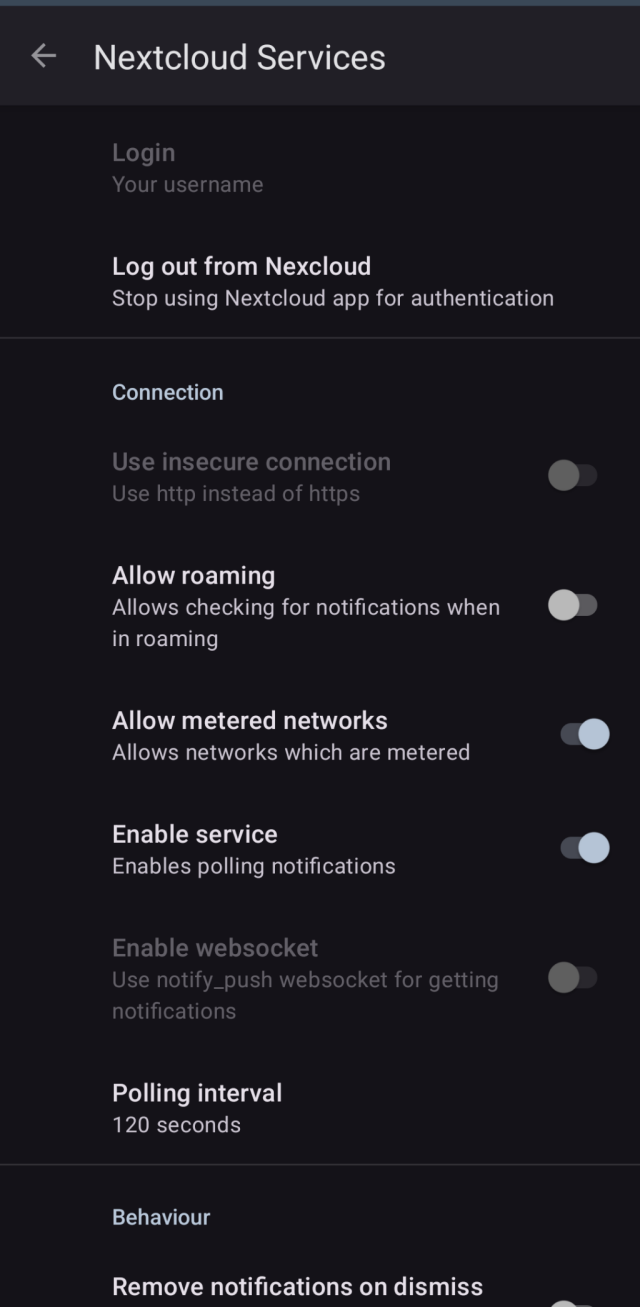
Ich hatte es erst die ganze Zeit mit der Nextcloud-App "UnifiedPush Provider" versucht, was aber gar nicht funktionierte, ich meine man benötigt da eine Redis-Datenbank auf seinem Server, was ich nicht habe. Naja ich hab dann die App "NextcloudServices" im F-Droid Store gefunden, da gibt man einfach seinen NC-Login ein, konfiguriert den Polling-Intervall und fertig. Kein Redis, kein Fire Cloud Messaging, kein Google Cloud Messaging, ganz easy ohne Datenschnüffelei und Datenbank-Gefummel.
Mein eingestellter Polling-Intervall liegt bei 2 Minuten, die Akkunutzung ist vernachlässigbar gering auch bei eingestellter Hintergrundnutzung/ausgeschaltete Akkuoptimierung.
Translated with DeepL.com (free version)
NextcloudServices | F-Droid - Free and Open Source Android App Repository
#Nextcloud #Android #GrapheneOS
Ich hatte es erst die ganze Zeit mit der Nextcloud-App "UnifiedPush Provider" versucht, was aber gar nicht funktionierte, ich meine man benötigt da eine Redis-Datenbank auf seinem Server, was ich nicht habe. Naja ich hab dann die App "NextcloudServices" im F-Droid Store gefunden, da gibt man einfach seinen NC-Login ein, konfiguriert den Polling-Intervall und fertig. Kein Redis, kein Fire Cloud Messaging, kein Google Cloud Messaging, ganz easy ohne Datenschnüffelei und Datenbank-Gefummel.
Mein eingestellter Polling-Intervall liegt bei 2 Minuten, die Akkunutzung ist vernachlässigbar gering auch bei eingestellter Hintergrundnutzung/ausgeschaltete Akkuoptimierung.
Translated with DeepL.com (free version)
I finally found a solution for receiving notifications from my Nextcloud on my GrapheneOS phone without Google Play Services. Specifically, I was interested in notifications from the Nextcloud Talk app.
At first, I tried the Nextcloud app “UnifiedPush Provider,” but it didn't work at all. I think you need a Redis database on your server, which I don't have. Well, I then found the app “NextcloudServices” in the F-Droid Store. You just enter your NC login, configure the polling interval, and you're done. No Redis, no Fire Cloud Messaging, no Google Cloud Messaging, very easy without data snooping and database fiddling.
My set polling interval is 2 minutes, and battery usage is negligible even with background usage enabled/battery optimization disabled.
NextcloudServices | F-Droid - Free and Open Source Android App Repository
Simply fetch Nextcloud notifications on devices without Google Play services
#Nextcloud #Android #GrapheneOS
Da Hubzilla ja alles, auch Bilder, Videos, Dokumente als Blob (Binary Large OBject) in der Datenbank ablegt schwillt die in kurzer Zeit ziemlich an. Meine z.B. hat nach 4 Tagen eine Größe von 1,2Gb. Ich hab 2 Wege gefunden das Problem zu lösen:
Administration - Seite - ganz nach unten scrollen:
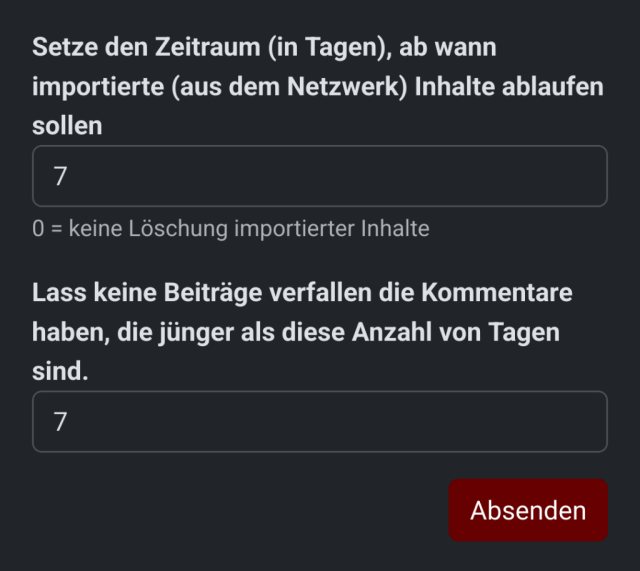
Setze den Zeitraum (in Tagen), ab wann importierte (aus dem Netzwerk) Inhalte ablaufen sollen
und
Lass keine Beiträge verfallen die Kommentare haben, die jünger als diese Anzahl von Tagen sind
Dabei werden Instanzfremde Inhalte mit denen deine Instsnz nicht agiert hat nach X Tagen gelöscht. Ich habe beide Werte auf 7 Tage eingestellt.
Translated with DeepL.com (free version)
Außerdem kann man mit folgendem Befehl seine Datenbank optimieren:
Der Befehl ist ein praktisches Hilfsmittel, das alle Datenbanken deines MySQL‑Servers durchgeht und für jede Tabelle ein OPTIMIZE TABLE ausführt. Kurz gesagt:
Was passiert dabei?
Fragmentierte Daten‑ und Indexdateien werden neu angeordnet.
Nicht mehr genutzter Speicherplatz wird freigegeben.
Die Zugriffs‑Performance kann sich verbessern, weil die Daten jetzt kompakter liegen.
Warum ist das nützlich?
Wenn du häufig INSERT/UPDATE/DELETE‑Operationen hast, können Tabellen im Laufe der Zeit „ausgelutscht“ werden. Das Optimieren hilft, die Performance wieder zu stabilisieren. Es reduziert die Größe deiner Datenbank‑Dateien, was gerade bei begrenztem Speicher praktisch sein kann.
#Hubzilla #Datenbank #MySQL
Administration - Seite - ganz nach unten scrollen:
Setze den Zeitraum (in Tagen), ab wann importierte (aus dem Netzwerk) Inhalte ablaufen sollen
und
Lass keine Beiträge verfallen die Kommentare haben, die jünger als diese Anzahl von Tagen sind
Dabei werden Instanzfremde Inhalte mit denen deine Instsnz nicht agiert hat nach X Tagen gelöscht. Ich habe beide Werte auf 7 Tage eingestellt.
Translated with DeepL.com (free version)
Since Hubzilla stores everything, including images, videos, and documents, as blobs (Binary Large Objects) in the database, it swells up quite quickly. Mine, for example, has a size of 1.2 GB after 4 days. I have found two ways to solve the problem:
Administration - Page - scroll all the way down:
Set the period (in days) after which imported (from the network) content should expire
and
Do not let posts expire that have comments younger than this number of days
Content from other instances that your instance has not interacted with will be deleted after X days. I have set both values to 7 days.
Außerdem kann man mit folgendem Befehl seine Datenbank optimieren:
You can also optimize your database with the following command:
mysqloptimize -ADer Befehl ist ein praktisches Hilfsmittel, das alle Datenbanken deines MySQL‑Servers durchgeht und für jede Tabelle ein OPTIMIZE TABLE ausführt. Kurz gesagt:
Was passiert dabei?
Fragmentierte Daten‑ und Indexdateien werden neu angeordnet.
Nicht mehr genutzter Speicherplatz wird freigegeben.
Die Zugriffs‑Performance kann sich verbessern, weil die Daten jetzt kompakter liegen.
Warum ist das nützlich?
Wenn du häufig INSERT/UPDATE/DELETE‑Operationen hast, können Tabellen im Laufe der Zeit „ausgelutscht“ werden. Das Optimieren hilft, die Performance wieder zu stabilisieren. Es reduziert die Größe deiner Datenbank‑Dateien, was gerade bei begrenztem Speicher praktisch sein kann.
The command is a handy tool that goes through all the databases on your MySQL server and runs OPTIMIZE TABLE for each table. In short:
What happens?
Fragmented data and index files are reorganized.
Unused storage space is freed up.
Access performance may improve because the data is now more compact.
Why is this useful?
If you frequently perform INSERT/UPDATE/DELETE operations, tables can become “worn out” over time. Optimizing helps to stabilize performance again. It reduces the size of your database files, which can be useful, especially when memory is limited.
#Hubzilla #Datenbank #MySQL